
The call option vs put option distinction is the single most important concept in options trading: a call gives the right to buy, a put gives the right to sell, and everything


Digvijay Singh Kanwar is the editor of Trade Day, where he covers stock, forex, options and derivatives, and crypto markets for Indian retail traders. He focuses on breaking down trading and investing concepts into clear, practical guides for beginners, with an emphasis on risk awareness and factual accuracy. His business and finance writing has also appeared on SiliconIndia, Travel Daily News, Home Business Magazine, and other publications. Connect with him on LinkedIn.
The call option vs put option distinction is the single most important concept in options trading: a call gives the right to buy, a put gives the right to sell, and everything

Comparing the best forex trading apps in India starts with a filter most comparison lists skip: whether the app is a SEBI-registered broker offering currency derivatives, or an offshore platform operating outside India’s regulatory framework. That single distinction matters more
Asking why is the stock market down today almost always has an identifiable answer within one of a handful of recurring categories – it’s
Understanding how global markets affect Indian stocks explains why your portfolio can move on a day with no major domestic news at all –

If you’ve ever opened your trading app and found no price movement, the answer to why is the market closed today is almost always a scheduled holiday – NSE and BSE follow
More
Cryptocurrency trading in India occupies an unusual legal position: it isn’t banned, but it’s taxed heavily and specifically as “Virtual Digital Assets” (VDA) under a framework introduced in 2022 that’s remained largely
More
Choosing among the best trading apps in India isn’t really about finding the single “best” one – it’s about matching a broker’s fee structure, platform features, and support model to how you
More
Learning how to read market news means learning to separate the headline from the actual signal underneath it. Every trading day brings a wall of numbers – Sensex up or down, global
More
Forex trading in India is legal only within limits set by the Reserve Bank of India (RBI) and the Foreign Exchange Management Act (FEMA) – and this single fact is what trips
More
The stock market is where shares of publicly listed companies are bought and sold, and in India it runs through two exchanges: the National Stock Exchange (NSE) and the Bombay Stock Exchange
More
A charge-by-charge comparison of Zerodha, Groww, Upstox and Angel One for 2026 — account opening, AMC, delivery, intraday and F&O brokerage — plus which suits which kind of trader.
More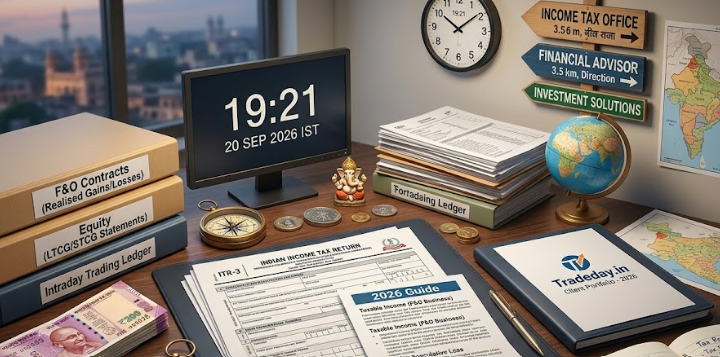
A clear breakdown of how capital gains, intraday trading, and F&O trading are each taxed in India — rates, rules, and a worked example.
More
SEBI's 2026 F&O rule changes explained: bigger contract sizes, fewer weekly expiries, higher STT, and a new algo-trading framework — and what it means for retail traders.
More
Options trading for beginners starts with two words: calls and puts. Everything else in options – strategies, Greeks, option chains – builds on understanding what these two contract types actually give you
More